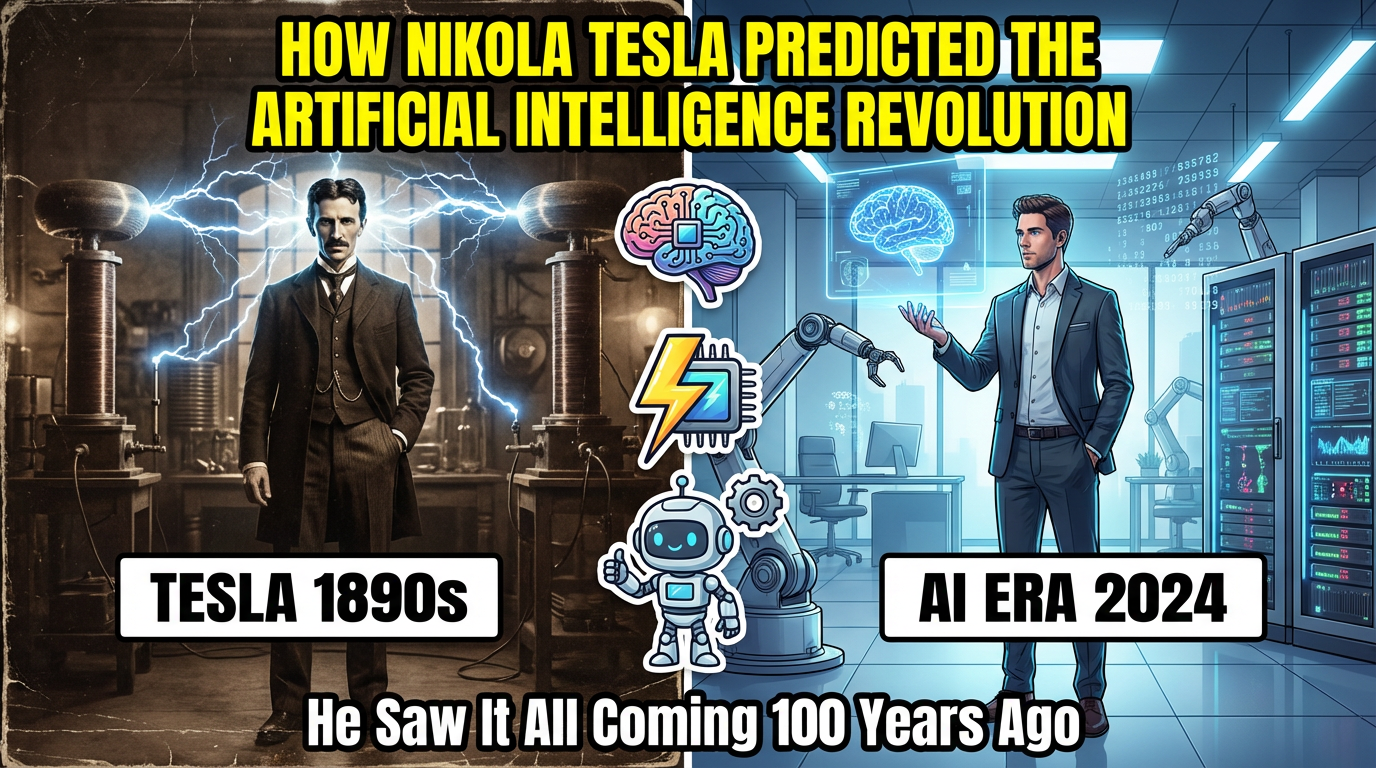
How Nikola Tesla Predicted the Artificial Intelligence Revolution The broke, forgotten genius who sketched out the future — and never lived to profit from it
What if the man who invented the future died with nothing — and Silicon Valley is about to make the exact same mistake?
Nikola Tesla never owned a smartphone, never wrote a line of code, and never lived to see a single silicon chip. Yet the artificial intelligence revolution unfolding right now is built on ideas he sketched out in hotel rooms over a century ago. Wireless energy. Machine cognition. A global information network he called the "World System." Concepts so far ahead of their time that his contemporaries thought he was losing his mind.
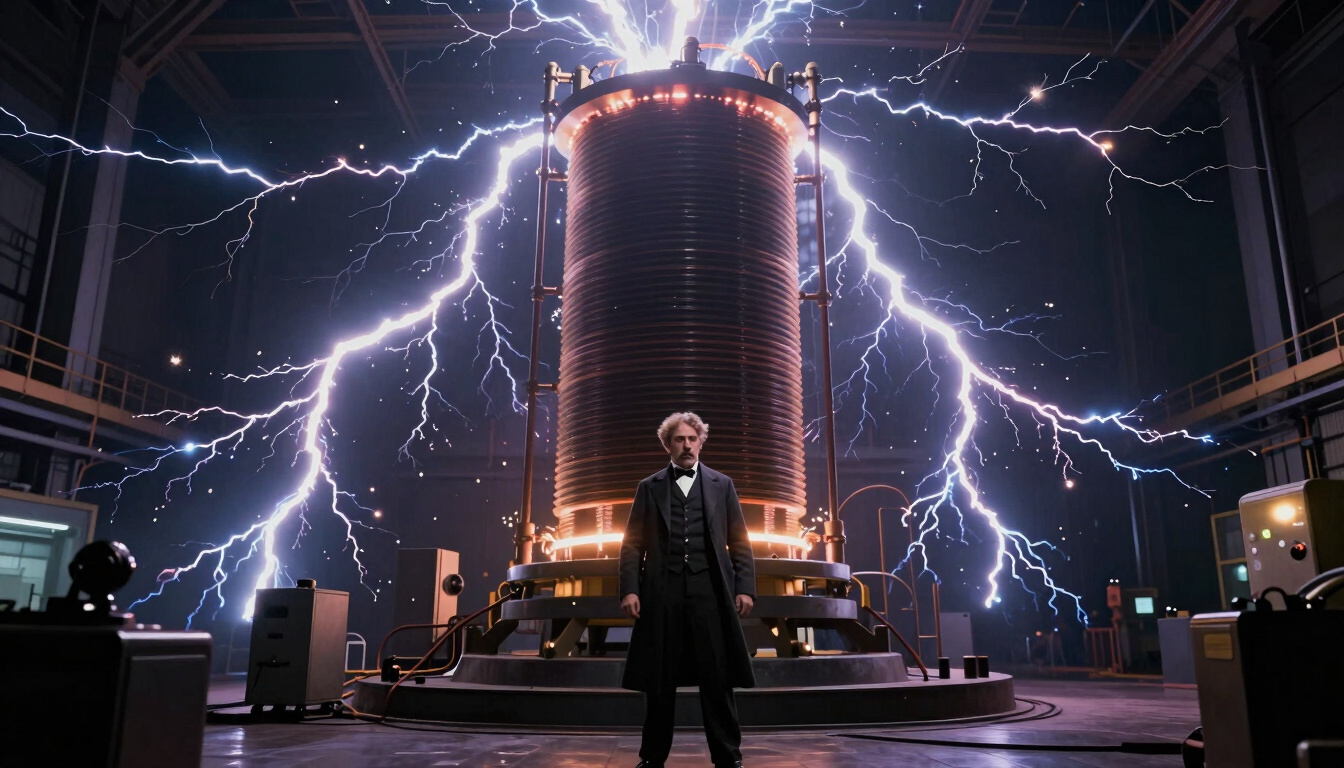
Born in 1856 in what is now Serbia, Tesla arrived in New York City in 1884 with four cents in his pocket and a letter of introduction to Thomas Edison. He developed alternating current — the AC power system that literally powers the world today — won the so-called War of Currents, and then proceeded to lose almost everything he built. His catastrophic falling-out with financier J.P. Morgan left him financially gutted after Morgan pulled funding from the Wardenclyffe Tower project, a structure designed to transmit wireless energy and communications globally. The reason? Free global wireless energy couldn't be metered. It couldn't be monetized. So it had to die.
Tesla spent his final decades in a New York hotel, running up debts, feeding pigeons, and filing patents the world wasn't ready to understand. He died in 1943. His estate was valued at roughly the cost of a used car. Today, the technologies he pioneered underpin a multi-trillion-dollar epoch — and the forces that crushed him are already at work inside the AI industry. This is the story the numbers tell.
By the Numbers
- $1,000 vs. $1 trillion. Tesla's total estate at death was valued at approximately $1,000. Tesla Inc. — the electric vehicle company Elon Musk named in his honor — crossed a $1 trillion market valuation in 2021. The man whose name adorns one of the most valuable companies on Earth profited from none of it.
- $150,000 then. $196 billion now. Morgan's initial investment in the Wardenclyffe Tower — equivalent to roughly $5.3 million today — was pulled before the project could be completed. The global AI market was valued at $196 billion in 2023 and is projected to hit $1.8 trillion by 2030. The infrastructure Tesla was building to democratize information and energy is now the foundation of the most capital-intensive technology race in history.
- 300 patents. $400 million in surrendered royalties. Tesla filed 300 patents across 26 countries during his lifetime. When he signed away his AC royalties to save Westinghouse from financial collapse, he forfeited an estimated $12 million in future earnings — over $400 million in today's dollars. He gave away the engine of the electrical age to keep the lights on for someone else's company.
The Business Read
Tesla's story is a masterclass in what happens when visionary innovation collides with misaligned incentives — and it maps onto the AI industry with uncomfortable precision. His fatal flaw wasn't his genius; it was his complete inability to control the commercialization of his ideas. Morgan killed Wardenclyffe not because it didn't work, but because a system that gave everyone free wireless energy couldn't generate a revenue stream. Sound familiar? Today's AI race is dominated by a handful of companies — OpenAI, Google DeepMind, Anthropic, Meta AI — all navigating the exact same tension between open, democratized intelligence and proprietary, monetizable platforms. OpenAI, which began as a nonprofit explicitly committed to ensuring AI benefits all of humanity, has restructured toward a capped-profit model and is now valued in the hundreds of billions. The Wardenclyffe question has been repackaged in a hoodie and a term sheet.
The parallel runs deeper than corporate structure. Tesla built the future for everyone and profited from it for no one. The AI industry is desperately trying not to repeat that mistake — aggressively patenting model architectures, locking foundation models behind APIs, and racing to establish platform monopolies before regulators understand what they're regulating. Whether that solution is better for humanity than Tesla's selfless surrender is a very different conversation. But the underlying dynamic — capital concentration determining who controls transformative infrastructure — is identical. The Morgan of this era isn't one man in a Manhattan office. It's a handful of sovereign wealth funds, hyperscaler cloud platforms, and venture syndicates who will ultimately decide which AI towers get built and which ones get quietly defunded.
What Tesla Got Right — And Wrong
Tesla got an astonishing number of things right. In a 1926 Collier's Weekly interview, he predicted that wireless technology would allow a man to carry a device in his vest pocket capable of communicating instantly with anyone on Earth. That is a smartphone, described with eerie precision ninety years before the iPhone. He envisioned a global brain — a unified network of knowledge accessible to all — which is essentially the internet layered with AI. He understood that energy and information were the twin engines of future civilization, a framework that reads today like a venture capital thesis. Three of the foundational technologies powering the AI boom — wireless communication, electrical grid infrastructure, and electromagnetic wave theory — trace direct lineage to his work.
But Tesla was a catastrophically poor judge of human systems, and that failure was just as consequential as his brilliance. He trusted Morgan without legal protection. He underestimated Edison's political savvy and PR instincts. He genuinely believed the elegance of his ideas would be self-evident to the world — that genius was its own argument. He had no communications strategy, no legal firewall around his patents, and no succession plan. Worse, he went deep into pseudoscience in his later years — claiming to have received signals from Mars, pursuing a "death ray" weapon — which eroded his credibility precisely when he needed it most. The AI world is full of Teslas right now: brilliant, underfunded researchers and founders who are one bad partnership, one misaligned investor, or one credibility-destroying pivot away from obscurity. Genius without strategic grounding isn't just a personal liability. It's a civilizational one.
The Strategic Takeaway
The most transformative technologies in history are almost never controlled by the people who invent them — and the gap between invention and ownership is where fortunes, and futures, are made or lost. The researchers publishing open-source models, the startups building on top of foundation models they don't own, the governments scrambling to regulate systems they don't understand — these are all characters in a story Tesla would recognize immediately. The lesson isn't to be cynical about innovation. The lesson is to be ruthlessly clear-eyed about who benefits from it, and to build the legal, financial, and ethical scaffolding before the Morgan of your era decides your tower isn't worth funding anymore.
"History does not repeat itself, but the incentive structures do. Every generation produces a Tesla — a mind that sees further than the market can price. The tragedy is not that such people exist. The tragedy is that we keep being surprised when the market wins." — The Economist, hypothetically, on the economics of visionary failure
Nikola Tesla died in Room 3327 of the New Yorker Hotel, alone, with an unpaid bill and a head full of ideas the world would spend the next century monetizing without him. The AI revolution he dreamed of is now valued at nearly $200 billion and climbing. His cut: exactly zero. The pigeons, at least, were grateful.