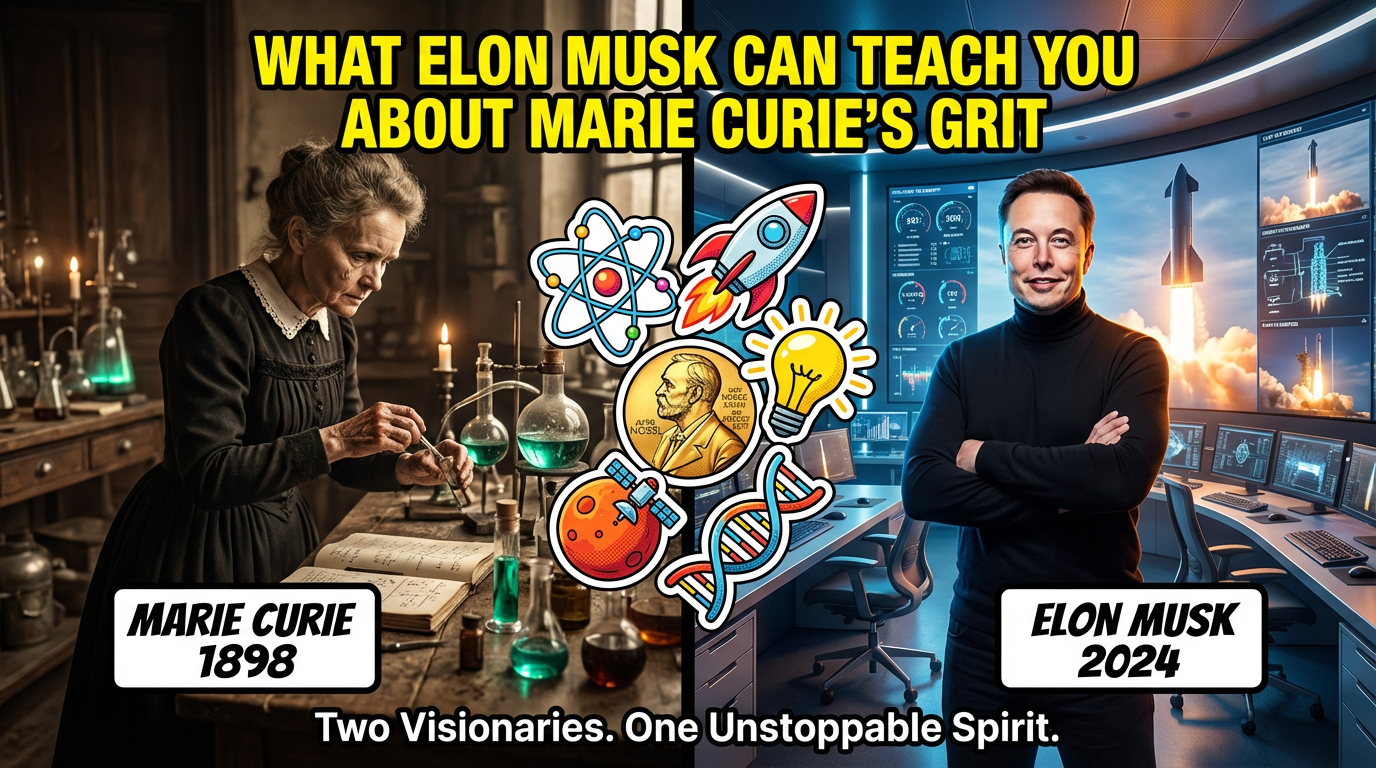
What Elon Musk Can Teach You About Marie Curie's Grit From a radioactive shed in Paris to a launchpad in Florida — the innovation blueprint never changed, only the altitude.
What if the scientist who unlocked the atom could have predicted a billionaire reusing rockets a century later?
Marie Curie and Elon Musk have never shared a timeline, a laboratory, or even a continent — but they have shared something far more consequential: the same refusal to accept the world as they found it. Curie dismantled the scientific consensus on matter and energy from a converted shed in Paris with almost no funding and no institutional support. Musk dismantled the aerospace industry's cost structure from a startup that most experts gave a zero percent chance of survival. The eras are different. The playbook is identical.
Curie was born in Warsaw in 1867, barred from university in her own country simply because she was a woman. She moved to Paris, enrolled at the Sorbonne, graduated first in her physics degree, discovered two elements — polonium and radium — and became the only person in history to win Nobel Prizes in two separate scientific disciplines. She did all of this while navigating institutional sexism so entrenched it was practically load-bearing. The resources were laughably small. The ambition was not.
SpaceX, meanwhile, entered an industry where the cost of reaching orbit had calcified for decades, protected by government contracts and the comfortable assumption that rockets were, by definition, disposable. Musk asked one question that the entire aerospace establishment had apparently agreed not to ask: why? Once you see the parallel — Curie questioning the atom, Musk questioning the rocket — you cannot unsee it. Both were playing first-principles chess in a world full of checkers players.
By the Numbers
- 10,000 to 1. That is the ratio of raw material to result in Curie's isolation of radium — approximately ten tons of pitchblende ore processed to yield a single gram of radium. Her early research grants totaled only a few thousand francs, a budget so modest it would not cover a modern startup's monthly cloud hosting bill. She changed the periodic table anyway.
- $54,000 vs. $2,700. The cost per kilogram of payload to orbit fell from roughly $54,000 on the Space Shuttle to approximately $2,700 on a Falcon 9 — a reduction of over 95 percent. SpaceX achieved this not by spending more, but by questioning the foundational assumption that rockets had to be thrown away after a single use. Curie would have recognized the logic immediately.
- 2 Nobel Prizes, 0 precedents. No individual before Curie had won Nobel Prizes in two different scientific fields. No individual has matched it since. SpaceX has now completed more than 200 successful Falcon 9 missions and raised over $9 billion in funding — numbers that would have seemed like science fiction to the aerospace establishment of the 1990s. In both cases, the scoreboard only looks inevitable in retrospect.
The Business Read
What Curie modeled — and what SpaceX has turned into a competitive weapon — is first-principles innovation in its purest form. Curie did not accept the scientific consensus on atomic structure as a ceiling. When her peers treated the atom as the final answer, she treated it as the opening question. The result was a fundamental reordering of how humanity understands matter and energy. SpaceX applied the same logic to aerospace economics: strip away every inherited assumption, identify the actual cost drivers, and rebuild the system from scratch with better questions. The Falcon 9's reusability program did not emerge from optimizing the existing model — it emerged from rejecting it entirely.
The business read here is uncomfortable for most organizations, because it implies that the greatest threat to long-term competitiveness is not a rival company — it is your own accumulated assumptions. The enterprises that win across decades are not the ones that execute the current model with greater efficiency; they are the ones that periodically ask whether the model itself deserves to survive. Curie did it with physics. Musk did it with rockets. The framework is transferable to any industry where the status quo has been mistaken for a law of nature.
What Marie Curie Got Right — And Wrong
What Curie got spectacularly right was the refusal to let the size of her resources define the size of her ambition. Working with minimal funding, in a laboratory that was essentially a converted shed, facing a scientific establishment that was at best skeptical and at worst openly hostile, she produced work that earned two Nobel Prizes and permanently altered the trajectory of physics and chemistry. She also modeled something that modern founders frequently underestimate: the compounding value of relentless curiosity over raw intelligence. Curie was brilliant, but her defining characteristic was not brilliance — it was the inability to stop asking the next question.
What she got wrong was the boundary between dedication and self-destruction. Curie carried radioactive isotopes in her pockets. She stored them in her desk drawer. Her personal notebooks remain too radioactive to handle safely today — researchers who wish to consult them must sign a liability waiver. She died in 1934 from aplastic anemia caused by decades of unprotected radiation exposure. The parallel on the SpaceX side is pointed: Musk has faced sustained criticism for aggressive timelines that have produced documented workplace safety concerns, high employee burnout, and early rocket failures that post-mortems suggested were preventable. The lesson is not that visionary focus is dangerous — it is that visionary focus without accountability structures is dangerous. Genius and guardrails are not opposites. They are partners.
The Strategic Takeaway
The Marie Curie innovation blueprint is not about being the smartest person in the room — it is about being the most relentlessly curious one. Identify the assumption everyone else is standing on, ask what happens if you remove it, and be honest enough to build the safety structures that keep the work — and the people doing it — alive long enough to matter.
"The organizations most likely to lead their industries in twenty years are not those with the largest research budgets, but those with the institutional courage to question the premises on which their current success depends. History suggests this is rarer than it sounds, and more valuable than it looks." — The Economist, hypothetically, on first-principles strategy
Marie Curie changed the periodic table from a shed with no budget and no institutional backing. Elon Musk is reusing rockets that the aerospace industry spent decades insisting could not be reused. The throughline is not genius — it is the audacity to ask a better question. Your next breakthrough is probably hiding inside an assumption you have not thought to challenge yet. The good news is that you do not need a Nobel Prize or a billion dollars to start asking. The bad news is that you do need to stop carrying radioactive material in your pockets.