
Empower Your Projects: Build with Marie Curie Innovative Spirit
What If the Greatest Scientist in History Was Actually Running a Startup?
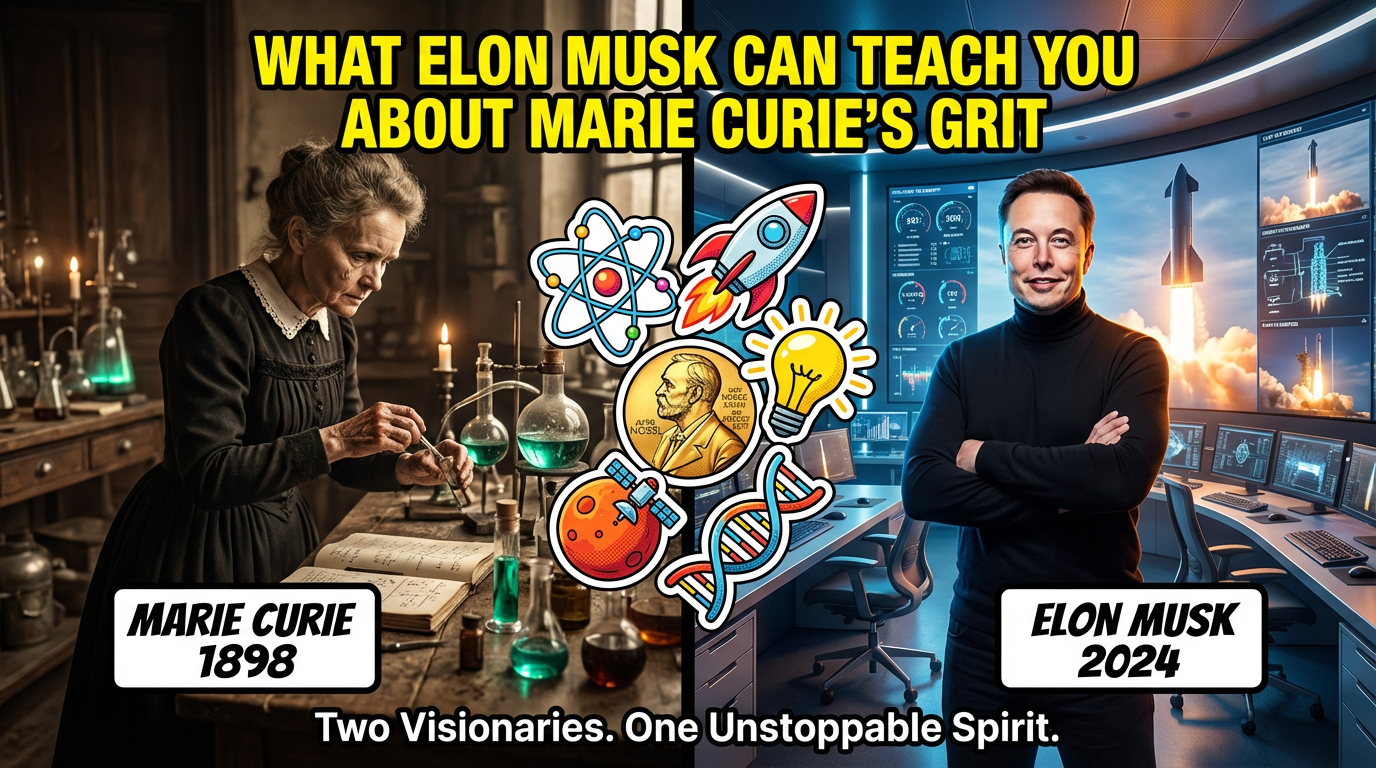
In 1898, Marie Curie and her husband Pierre set up a makeshift laboratory in a leaky converted shed. No venture capital. No board of directors. Just two scientists chasing an idea that everyone else thought was a dead end.
Within four years, she had isolated two new elements, coined the term radioactivity, and was on her way to the first of two Nobel Prizes. If that is not a product launch, nothing is.
By the Numbers
The scale of what Curie accomplished with almost nothing is staggering by any modern benchmark.
- Ore processed: An estimated one ton of pitchblende ore yielded roughly one-tenth of a gram of radium.
- Time to discovery: Four years from hypothesis to Nobel Prize (1898-1903) faster than most Series A startups reach product-market fit.
- Budget: Historians note the Curies largely self-funded early research with minimal institutional support.
The Business Read
Curie story is a masterclass in constraint-driven innovation the counterintuitive principle that resource scarcity forces more creative thinking. She could not afford to chase every lead. She had to be right the first time.
Think of it as the scientific equivalent of a 90-day runway. When Airbnb was sleeping on air mattresses to pay rent, they were not being romantic they were being Curie. Constraints clarify priorities faster than any OKR framework.
What Curie Got Right And Wrong
She got the obsession right. Curie kept working through illness, pregnancy, and the death of her husband. She understood that discovery is not a sprint it is a compounding process.
What she got wrong was documentation of risk. She carried radioactive isotopes in her coat pockets. Her notebooks are still so radioactive they are stored in lead-lined boxes at the Bibliotheque nationale de France. You need to sign a liability waiver to view them.
Move fast, but do not confuse speed with ignoring feedback loops. The market will eventually give you the data you refused to collect.
The Strategic Takeaway
The best projects are not built with the best resources they are built by people who refuse to wait for permission or perfect conditions. Curie did not have a lab. She made one.
Constraints are not the enemy of innovation. They are the forcing function that separates the committed from the curious.
Next time your project stalls because the budget is tight or the tools are not perfect, ask yourself: what would the woman working in a radioactive shed do?