
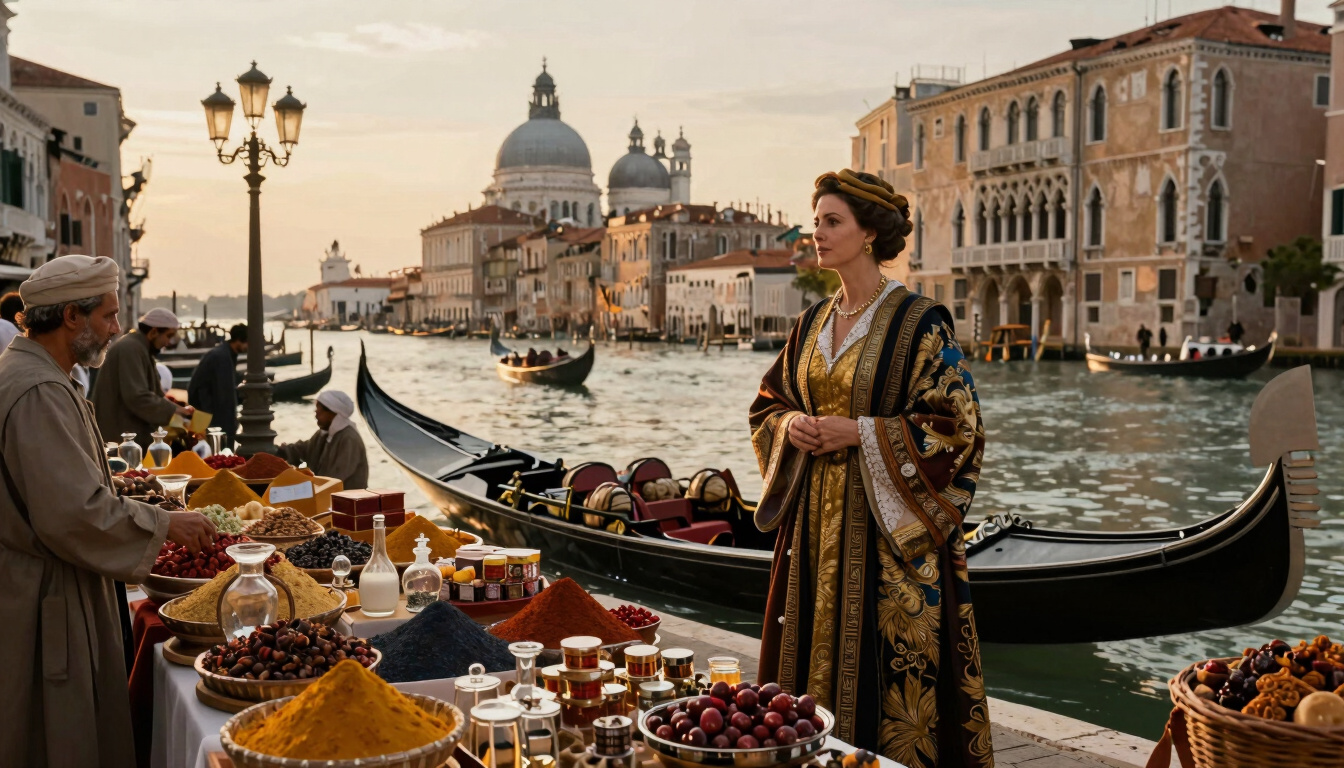
What Rihanna Can Teach You About Venetian Merchants
The 600-Year-Old Playbook Behind Fenty Beauty's Billion-Dollar Strategy
What if the world's most disruptive beauty brand was actually running a medieval trade empire playbook?
In 2017, Rihanna launched Fenty Beauty with 40 foundation shades — a radical act in an industry that had spent decades ignoring half the world's skin tones. The move was called revolutionary. Visionary. Unprecedented. Except it wasn't. Not really.
Five hundred years earlier, in the crowded trading halls of 15th-century Venice, merchant women were doing something strikingly similar: identifying underserved markets, sourcing products no one else would touch, and building diversified portfolios of goods that spoke to a multicultural clientele stretching from the Adriatic to Alexandria. They weren't just selling. They were building brands.
Rihanna may have never cracked open a book on Venetian commerce, but she executed their playbook flawlessly. Here's what the Serenissima's forgotten businesswomen already knew about winning markets — and what every entrepreneur today still needs to learn.
By the Numbers
The scale of Venetian merchant ambition — and Fenty's — is staggering when you put the numbers side by side:
- $1.4 billion: Fenty Beauty's valuation just two years after launch, making Rihanna one of the wealthiest self-made women in entertainment history.
- 40 shades at launch: Fenty's foundation range — compared to the industry standard of 10-15 — mirrored Venice's strategy of sourcing goods for every market segment, from North African kohl to Levantine rose oils.
- 300+ trading partners: The number of distinct trade routes Venice maintained at its commercial peak in the 15th century, each catering to different cultural tastes and product demands across three continents.
The Business Read
The Venetian Republic was, at its core, a diversification machine. Its survival depended on never betting everything on one product, one route, or one buyer. Merchant women who operated in this ecosystem internalized this principle at a cellular level. They stocked Byzantine silks alongside Moroccan leather, Murano glass alongside Egyptian papyrus.
Fenty Beauty did exactly this. Where other celebrity beauty lines launched a lipstick or a perfume and called it a brand, Rihanna built a portfolio play from day one — anchored to a single unifying brand promise: you belong here, whatever your skin tone. That's not a product launch. That's a market positioning strategy.
What the Venetian Merchants Got Right — And Wrong
The merchant women of Venice were ahead of their era in almost every way that mattered commercially. They understood segmentation before the word existed. They practiced relationship-based commerce — building trust with suppliers across cultural and religious lines — at a time when most European traders refused to deal with Muslim or Jewish merchants. This cross-cultural partnership was a direct source of competitive advantage.
But Venice made one catastrophic strategic error: it became so dependent on its geographic position as the gateway between East and West that it failed to adapt when Vasco da Gama opened the sea route to India in 1498. Route dependency killed the empire. Fenty faces a modern version: founder dependency. When the brand's identity is tightly coupled to one person, the risk profile looks eerily familiar.
The Strategic Takeaway
Inclusion isn't charity — it's the most rational business strategy ever devised. Every underserved market segment is a mispriced asset. Venice's merchant women knew this in 1450. Rihanna operationalized it in 2017.
"The merchant who stocks only what her neighbors buy will always be poorer than the one who stocks what the world needs."
The real plot twist? Venice's most successful female merchants operated in a system that officially didn't recognize their full legal personhood — and still built fortunes that funded palazzos, dowries, and dynasties. Rihanna built hers in an industry that told dark-skinned women their money wasn't worth chasing. Some markets never change. Fortunately, neither does the playbook for disrupting them.